Showing posts with label ingredients. Show all posts

Friday, November 25

2 Ingredients to Watch for Under Your Christmas Tree!

Today I was reminded of why I started making skin care products - even the "natural" companies, aren't living up to their promises! In my mailbox today I found a newsletter (more like a newsPAPER!) from one of the biggest commercial companies toting the natural vibe. Now although this big company (that starts with an "L" and ends in an "H"), makes products that are better than a lot of what's available out there, they are still using two ingredients (in the majority their products) that are on most "dirty dozen" lists of ingredients to avoid.

I previously talked in length about one of those ingredients, parabens, in a previous blog post. A summery of their danger is that they mimic hormones and are readily absorbed into our skin. You'll find these at the end of the "Big L's" ingredients lists for many of their products.

The second shameful ingredient that the big L adds to pretty much anything that bubbles, suds, or fizzes, is SLS (Sodium Lauryl Sulfate). I'm sure I've mentioned this problem ingredient on many occasions but since I don't have a blog post summarizing what it is and why you'll want to avoid it, now is the time! The last thing we all want is to start a new year bathing and soaking in chemicals! Without further a do, here's what makes SLS so shameful!

What Sodium Lauryl Sulfate (SLS) and Sodium Laureth Sulfate (SLES) are:
They are forming agents in the most basic terms. They create bubbles, form, and clean. They are some of the most widely used sulfates because they cheap. The almighty dollar strikes again. You'll find these sulfates in all kinds of bath and body products including bath bombs (the big L is notorious for SLS in their bath bombs), shampoo, body wash, bubble bars (I've never seen one made without SLS or SLES), tooth paste, dish soap, bubble bath, shaving cream, etc. SLES is said to be the milder of the two, but its effects seem to be much more long lasting.

Why they should be avoided:
  • Concentrations as low as 0.5% can cause irritation.
  • Concentrations of 10-30% can cause skin corrosion!
  • Rashes, scalp scabs, canker sores, dry skin patches
  • Color stripping
  • Stripes shine from hair
  • Penetrates skin easily and can't be metabolized by our liver
  • Possible endocrine disruptors
  • Not just skin and scalp irritants, they are also eye irritants
  • Contamination with 1,4 dioxane (cancer causing)

How to spot them on labels:
They will be listed exactly how I've listed them in this post (minus the abbreviation):
  • Sodium Lauryl Sulfate
  • Sodium Laureth Sulfate


Today's take away:
Read labels! It's the only way to see through marketing hype to know if you're getting a natural, safe, skin loving product, or you're getting something that seems wondering but actually contains cancer causing ingredients! Again, watch out for any ingredient ending in -paraben, and watch out for Sodium Lauryl Sulfate and Sodium Laureth Sulfate


Share

Friday, July 1

Video: Happy Canada Day Plus What You Need to Know About Sunscreen


HAPPY CANADA DAY!!!!
Share

Skin Care: Skin Type & Products Talk (the video version)


See the original blog post here.


Share

Tuesday, June 28

Skin Care: Factors Influencing Your Skin Type (the Video version)


Part 2 of the skin type talk.
See the blog post here:
http://battysbath.blogspot.com/2011/05/skin-care-factors-influencing-your-skin.html


Share

Wednesday, June 22

How To: Natural DIY Hair Gel

I recently got asked on the Batty's Bath Facebook Fan Page about natural hair styling products. I wont be adding any to the Batty's Bath line any time soon because they are super easy for you to make at home! This natural hair gel is so easy to make I almost didn't think it was worth a whole blog post lol! But, since it's not common knowledge and makes a great gift for those hard to buy for boyfriends, husbands, brothers, and dads, I couldn't help but share it here! Bookmark this post so when you get stuck for what to get those dudes for their birthdays or Christmas you'll have a quick and easy solution! :)

It's interesting to note that this recipe is versatile and rich in omega 3s - omega 3s encourage hair growth! Another interesting point is that the flaxseeds you'll use in this recipe are the same thing that many companies use in their products and it's what flappers used in the 20s to create that pin-curl look!

Enough with introductions though, let's get to the recipe...


NATURAL DIY HAIR GELL

What you'll need:
  • Ground Flaxseeds
  • Water
What to do:
  • Boil 1 cup of water
  • Add 1-2 tablespoons of flaxseeds
  • Mix
Tada! You're done! I told you it was super easy! You just created a frothy gel-like consistency that makes for a nice, strong hold (plus sexy shine) hair gel!


Share

Monday, June 13

Parabens - How to spot them on labels

In the past I've talked about what parabens are and explained why all of my products are paraben free but I feel it's worth repeating. The point of this post isn't to just repeat a post I've written previously, but instead, I'm going elaborate on my previous post by including how you can spot parabens by reading the labels on your favorite beauty products.


First, let's do a quick review....


Parabens are preservatives used in over 70% of all beauty products. This is why you NEED to know how to spot them because you can bet that if you've bought something from the drug store, mall or department store lately, there's a good chance it has parabens in it.


Why you should avoid them
  • one study showed that they can age the skin with exposed to UV light
  • another study showed that they mimic estrogen
  • they have been found in breast tumor tissue
  • contrary to what was previously thought, they can penetrate the skin and migrate into body tissue


Now let's learn how to spot them!


If you have never read an ingredients label on a beauty product before, now is the time to start. When you do - don't freak out! If it's a commercially made product, the ingredients list is going to be HUGE with super long unpronounceable words, but I'm here to help you out! There's lots of things to look for on ingredients list, but we're going to start with baby steps and ease into things. If there's anything I've learned from my university years, it's don't try to learn EVERYTHING all at once. Instead, start with something that's manageable and build your knowledge bank from there. Today we're going to start with parabens.

The great thing about starting with parabens is that they are pretty easy to spot on a label because the name of the ingredient generally ends with "paraben"! Parabens aren't awesome but it's awesome that some of the most common ones include the word "paraben"! There are a few that are a bit tricker to spot but thankfully the list of incognito parabens is short


Here's the most common parabens you'll find on ingredient lists:
  • methylparaben
  • ethylparaben
  • isobutylparaben
  • propylparaben
  • ... (other variations ending in paraben can be spotted as well)
  • hydroxybenzoic acid
  • hydroxybenzoate


There you have it! Go grab the products you use everyday and check out those labels! You'll be glad you used your new label reading skill to protect you and your family!

Stay tuned to the blog or join the mailing list for more "ingredient spotting baby steps" you can take!


Share

Tuesday, June 7

What You Need to Know About Sunscreen

The signs of summer have certainly shown themselves lately. Over the past few weeks I've been asked more times than I can count about natural sunscreen; mainly, "Do you make natural sunscreen or know where I can get a good natural sunscreen that isn't gross?"

After a lot of consideration, a discussion the fan page, and mulling it over with a close friend, I've decided NOT to make natural sunscreen, at least not for sale. I'll be making it for myself and my fiance, but I decided not to offer it for sale mostly because of the regulations AND my fear that with a natural sunscreen in hand some people will throw everything they know about being "sun safe" out the window. That scares me more than anything!

So if you can't get a natural sunscreen from Batty's Bath, what should you look for? Well, I'm going to answer that question by informing you on what to look for in a natural sunscreen and what to watch for (i.e. run away from)! There's a few ingredients in "chemical" sunscreen, and sunscreens claiming to be "pure" or "natural" that you need to learn so you can steer clear of them! Let's get started...

First up, the good guys...

When looking for a natural sunscreen look for ingredients that protect you from the sun by physically blocking & deflecting the sun's UVA and UBA rays. These include zinc oxide and titanium dioxide. One thing to note though when looking for sunscreen with either of these two natural ingredients is making sure that they are not used in nano form. What does nano form mean? Well Nanoparticles are very controversial right now. It refers to the size of the actual minerals and at the smallest size, they can penetrate the skin easily. Because of this, some experts are concerned about particles entering the body and accumulating in body tissue or getting into place they shouldn't be (for example, your cells). So what do you need to now to avoid purchasing a product that could have nanoparticles? First you need to know that you want the particles to be larger than 100 nanoparticles. If the packaging or description doesn't say, ask!


Next up, the bad guys.....

This is not one of those times when going after the "bad boy" isn't as exciting as it was when you were teenager! In fact, playing around with these "bad boys" can have much more serious effects than a good cry over a tub of ice cream! This group of ingredients are found in chemical sunscreens and protect you from the sun by absorbing UV rays before they have a chance to damage your skin. When looking for this list of bad boys, check out any products with "SPF" on the label, especially if they don't mention that it is a mineral or physical blocker that's protecting you. So who are the bad boys? Without further ado, here's how you'll find them on an ingredients list: padimate-O (PABA), benzophenone (oxybenzone), homosalate, and octylmethoxycinnamate (octinoxate).


So what makes these ingredients so bad?

First, padimate-O (PABA) is a physical blocker (not a bad thing) but it is also a suspected carcinogen. Second, Oxybenzone (benzophenone) has shown endocrine disruption in animals, although the relevancy of this finding is debated as some experts claim that it doesn't enter the human bloodstream in any meaningful way. Third, the remaining ingredients are suspected of messing with hormones. Yikes!


So why care about the effects of the sun in the first place?
According the Canadian Cancer Society, "Natural sunlight is important for good health. But too much exposure to the sun’s rays can cause skin cancer and eye problems. Being safe in the sun can go a long way in protecting yourself and your family. There is no safe way to get a tan. Tanning beds and sun lamps are not a safe alternative. The more you use tanning beds and sun lamps, the greater your risk of getting skin cancer." - Canadian Cancer Society Website.

So we're not talking about the difference between being pretty in pale, and being tremendously tanned, ... we're talking about keeping you safe from too much sun exposure that causes skin cancer! If you haven't taken this seriously in the past, this is the year to start!

Hoping to see all you lovelies the same shade this summer as you were this winter ;)


Share

Tuesday, May 17

The Benefits of Soy Butter


Soy Butter is used in our "wet" clay mask. Out of all the wonderful butters that nature has to offer you might be wondering why I picked soy butter. There wasn't just one reason to pick soy butter, but many! It's such a wonderful ingredient that has so many good qualities! Check out the list below to learn about what's so great about soy butter!!

  • Since it is made from soya beans, it is extremely high in lecithin, sterolins, vitamin E, omega 3 fatty acids and isoflavones.
  • It penetrates easily into the skin which makes it an effective moisturizing agent.
  • It re-hydrates and replenishes the skin’s lipid barrier to help hold in moisture while softening dry, chafed, and damaged skin.
  • It exhibits good spread-ability on the skin, making it ideal for a facial clay mask.
  • It has an extremely mild scent making it great for people who are sensitive to strong orders, fragrances, and scents.


Share

Monday, May 9

What Olive Green Clay Really Does for Your Skin

Our primer has it, our facial masks has it, and even our cucumber facial soap has it... what is it? It's Olive Green Clay!

Olive Green Clay is our "go to clay" around here because it's strengthening for all skin types! This clay has got it going on ;) It's the strongest of all clays for detoxification - something that is essential to keeping skin clear and health which makes it vital in the care of acne-prone and oily skin.

So what else is so great about this clay? The detoxification properties already make Olive Green Clay absolutely amazing but it does more than just that! The minerals in the clay help to rebalance oil flow (another essential element of controlling breakouts), strengthens the skin, and aids in the repair of scars (an added bonus for those of us who have scars left over from previous or long-term breakouts!). The repairing properties for scars also makes Olive Green Clay ideal before, during, and after pregnancy where stretch marks are of concern.

So the next time you're applying our primer, facial masks, or soaping up with our cucumber facial soap, you know exactly what that wonderful clay is actually doing for your skin! It's a good feeling isn't it? :)


Share

Tuesday, April 26

5 Reasons to Buy Handmade Soap

5 Reasons to Pamper Yourself with Handmade Soap!

1. You value the largest organ in your body - your skin
- and know that without the 3000 square inches of skin on your body, you wouldn't survive. It's definitely worth taking care of!

2. You don't want to have your skin rough, red, and dry after a shower or bath! You know that industrial manufactured soaps have harsh chemicals & detergents that cause just that! How? These harsh ingredients strip your skin of its natural moisturizers, irritate may people's skin, and even CAUSE may common skin problems!

3. You love that handmade soap is free of harsh ingredients and instead is made with natural oils, butters, and clays in particular combinations for various skin types! It's designed with specialized skin care in mind - not profits or bottom lines!

4. You LOVE Glycerin and each and every bar of handmade soap contains loads glycerin. Why do you love glycerin so much? Because glycerin draws moisture from the air into your skin! Is your skin craving moisture? If you're using industrial manufactured soaps you can bet it is because the glycerin is removed from these soaps and sold off for profit! Since the glycerin is removed from these industrial manufactured soaps, they replace that skin loving glycerin with poor quality fillers and detergents

5. You value affordable luxury and know that the simple things in like bring the most joy! Using handmade soap is like treating your skin to some serious pampering everyday! If you ever wanted to feel totally pampered on a small budget, handmade bath & body products are the way to go!


Share

Wednesday, March 30

Alternative Uses for Vodka


Treat Poison Ivy
For many, one of the hazards of enjoying the great outdoors is an encounter with poison ivy, oak or sumac. It can lead to a nasty, long-lasting rash. Unfortunately, poison ivy is spreading, thanks to global warming. To avoid the uncomfortable reaction, immediately pour vodka on skin that has come into contact with poison ivy, and the alcohol will wash away the itchy culprit, urushiol oil. Some have said that the vodka needs to be at least 100 proof to work. Others have argued that straight rubbing alcohol works better.

Freshen Laundry
You can keep your clothes smelling fresher with vodka — really! Simply spritz your duds with the stuff, then hang to dry in a well-ventilated area. (Do a spot-test first to be safe.) Vodka kills odor-causing bacteria, but doesn't leave a scent when dry.

Shine Your Fixtures
Moisten a soft, clean cloth with vodka, then apply a little elbow grease.

Preserve Flowers
If vodka can help you find love, then it can also help you preserve it — or at least the symbols of it. Add a few drops of vodka and a teaspoon of sugar to the water in your flower vase. It should help keep your flowers fresh longer. Change out the mixture with fresh ingredients daily.

Repel Insects
Who knew that vodka can kill pesky insects? Pour a little of the saucy spirit in a spray bottle and squirt on the little buggers, or yourself as a repellent. But please don't take aim at any beneficial bees!

Soothe Jellyfish Stings
For vegetarians and others who don't travel with meat tenderizer (or who don't feel comfortable asking friends to, um, relieve the pain), take heart. Vodka can also disinfect and alleviate some of the bite of a jellyfish sting. (Batty Bite: When I was younger I was stung by a jelly fish but we were told by the lifeguard to rub sand on it. It was way too long ago for me to remember if it actually worked but I do remember the sting being very painful!!!)

Clean Away Mold
Fill a recycled spray bottle with some bottom-shelf vodka. Spritz on, then let sit for 15 minutes. Scrub away with an old toothbrush

Make a Soothing Lavender Tincture
Do you find the scent of lavender soothing? Did you know that herbalists have used it for generations to naturally ease aches and pains? Here's a fun DIY tip: Fill a clean glass jar with fresh lavender flowers, then top off with vodka. Seal the lid tightly and place in the sun for three days (same idea as making sun tea!). Strain the resulting liquid through a coffee filter, and poof! You have a homemade tincture to rub into aches and pains. You can pour into smaller bottles, decorate them and give them as unique gifts.

Ease a Toothache
Got a toothache? Your first priority should be to see a dentist. But sometimes you can't get an appointment right away, or the professionals tell you it will just have to heal on its own. In that case, try swishing a shot of vodka over the affected area. It can help disinfect, and should numb some of the pain in your gums. Just beware that your honey may accuse you of smelling like a saloon. Share

Sunday, March 20

Dead Sea Salt: Is it really better?

Today we take a look at one of the ingredients I use in my B&B products: Dead Sea salt!

Dead Sea Salt refers to salt extracted or taken from the Dead Sea. It is a popular ingredient of many common bath products including bath salts, salt scrubs, foot scrubs, body wraps, bath bombs, soaps, and a wide variety of other cosmetic products, including makeup.... but is it all it's cracked up to be? It appears so!


Dead Sea salts have been reported to have the following benefits:
  • Rheumatologic Conditions – Dead Sea salts can be effective in balneotherapy of Rheumatoid Arthritis, Psoriatic Arthritis, and Osteoarthritis. The minerals are absorbed while soaking, stimulating blood circulation.
  • Common Skin Ailments – Research has demonstrated that skin disorders such as acne and psoriasis are relieved by regular soaking in water with added Dead Sea salt. The National Psoriasis Foundation recommends Dead Sea and Dead Sea salts as effective treatments for psoriasis. One study concluded that the high concentration of magnesium in Dead Sea salt was instrumental in improving skin hydration and reducing inflammation. Another study conducted at the University of Negev, Israel also looked into the claims of Dead Sea Salt and found that although common salt provides benefits to psoriasis suffers, Dead Sea Salt does a slightly better job at reducing it's symptoms (when soaking it salt baths regularly).
  • Allergies - The high concentration of bromide and magnesium in the Dead Sea salt can relieve allergic reactions by cleansing and detoxifying.
  • Skin Aging – Further research into Dead Sea salt benefits has shown a 40% reduction in the depth of wrinkling.


Share

Wednesday, March 16

What is Fair Trade? Fair Trade in Skin Care Products

Batty's Bath only purchases ingredients from Fair Trade Compliant companies and I often get ask what exactly this means. The fair trade program has come out of the human rights & ethics movement. It's in place because many people (such as myself) are sickened that already impoverished countries are continuing to be exploited for their resources.

The basics of Fair Trade are...
...that the profits go back to the communities that produce the goods, that environmentally friendly production methods are used, and that forced labor is never used. I couldn't sleep at night if I wasn't doing what I could to ensure that each aspect of my business is only helping and not hindering anyone, anything, or any place. It's a high ethical calling but I can't imagine running a business any other way.


For more information about fair trade, check out what About.com says about it:

--------------------------------------------

What is Fair Trade? Do you ever wonder what the term "Fair Trade" means when you are shopping for skin care and beauty products? Here are the fair trade basics when it comes to skin care and beauty products.

When you're shopping for skin care and beauty products, you likely will notice when a product label reads "Fair Trade", but you might be wondering, "What is fair trade"?

When you look at the list of ingredients your product has, you may notice ingredients such as cocoa butter, shea butter, aloe and seaweed, just to name a few, that make the skin care products what they are. These natural ingredients come from farmers who provide to the skin care companies.

What typically happens is that the farmer sells to a middle man, who may sell to another middle man, who then sells to the company who makes the products. This leaves the farmers who produced the ingredients with only a small piece of the profits they worked so hard for. Many times the farmers and communities are taken advantage of, and are left to take what they can, instead of what they deserve.

When a company chooses to get these ingredients in a way that treats the producers fairly, they work directly with them and pay them a fair wage for their work, and their product.

Many times these working relationships coincide with marginalized communities who make their entire living producing and harvesting. Having a fair trade contract gives them the money they deserve, getting out of poverty, creating an opportunity for children to go to school, giving the community the funds to provide what is needed, such as water wells and hospitals for example.

While fair trade is growing in popularity, it is definitely not the norm. If you would like to support marginalized communities with your everyday purchases, read labels, ask employees and do your research. If you're going to make a purchase anyway, it's always nice to know that your purchase made a direct impact for the good.


{Source}


Share

Monday, March 14

Easy Green & Natural Polisher You Can Do at Home!

Although I've never tried it myself, I've read that pineapple is natural skin polisher that comes with a clinical proof of efficiency! Apparently, just rubbing your skin with a slice of pineapple works magic on dilated pores and minor skin flakiness.

So what is it about pineapple that makes it so special? Bromelain! Pineapples have an abundance of this enzyme that is clinically used as a skin debrider (dead tissue remover) when treating burns.

Additionally, I found out that in a study done by the University of Honolulu, the researchers found that bromelain interferes with growth of malignant cells (essentially slowing down the growth of these malignant cells ) while also decreasing inflammation! Now that's some sweet stuff :)


Share

Monday, March 7

Natural Focus: Herbs That Help with Anxiety

Passionflower - an ingredient that is often used in natural medicine, alleviates hyperactivity, anxiety, insomnia, nervous tension -- and is even sometimes used to treat Parkinson's Disease. Passion flower soothes and calms and can lower high blood pressure.

Lemon balm - a general restorative for the nervous system, can reduce blood pressure and also calm the digestive system.

Lavender - an excellent anxiety treatment and one of the best natural panic attack treatments. Lavender is a general tonic for the nervous system and a natural relaxant.

Valerian - a popular natural ingredient that can be used as a sedative and a painkiller. It is often effectively employed as a treatment for anxiety and for insomnia, as well.


Share

Tuesday, February 15

Rosacea Skin Care


Wondering if You have Rosacea?
Rosacea is a frustrating skin condition that begins subtly, with the intermittent appearance of redness along the cheeks and nose. If left untreated, rosacea almost always worsens. Read More

Here are the signs to look for:

  • Red flushing over the cheeks and nose
  • Consistent, though random, and often extreme skin sensitivity
  • Acne-like bumps (but the bumps are not acne)
  • Flakey skin, sometimes accompanied by oily skin
  • Visible tiny blood vessels that may become more noticeable over time
  • Other concerns, which can still be present: dry skin, wrinkles, sun damage, and skin discolorations
  • Almost anyone can get rosacea, but those affected most often are lighter skinned women. Men are less likely to have rosacea, but when they do, they have more noticeable problems, including swollen bumps along the nose called rhinophyma.


What causes rosacea?
Although the exact cause of rosacea is unknown, various theories about the disorder's origin have evolved over the years. Facial blood vessels dilate too easily, and the increased blood near the skin surface makes the skin appear red and flushed. Various things -- called trigger factors -- can increase this redness response. Acne-like bumps appear, often in the redder area of the central face. This may be due to factors related to blood flow, skin bacteria, microscopic skin mites (Demodex), irritation of follicles, sun damage of the connective tissue under the skin, an abnormal immune or inflammatory response, or psychological factors. None of these possibilities has been proven, although potential inflammatory pathways have been identified in recent ongoing research -- including an immune response triggered by a type of antimicrobial protein known as cathelicidin. A recent study also found that certain bacteria present on otherwise harmless Demodex mites could prompt an inflammatory response in rosacea patients.


What You Should Eliminate from Your Skin-Care Routine:
If you have rosacea, it is critical that you eliminate the parts of your normal skin-care routine that increase inflammation, and make skin redder, such as the following:

  • Harsh cleansers such as "beauty bars" that contain detergents
  • Drying liquid or lotion cleansers (again, that contain detergents)
  • Toners with alcohol and fragrance
  • Abrasive scrubs
  • Rough washcloths
  • At-home facial peels
  • Using too many products at the same time.


What to Eliminate: Specific Ingredients
Skin-care ingredients that make rosacea worse include the following, and, shockingly, they often show up in skin-care products whose labels claim they are specifically for those with rosacea:

  • Fragrant plant extracts such as cinnamon, rosemary, lavender, and rose
  • Some Synthetic fragrances
  • Lemon, lime, menthol, peppermint, pine, and cedar
  • Alcohol
  • Witch hazel


Share

Saturday, February 12

What are the benefits of Jasmine?

Did you know that Jasmine's warm, floral aroma, soothes aching muscles, induces sound sleep and the scent is reportedly an aphrodisiac! It is a sensual, soothing, calming oil that promotes love and peace.

Since ancient times, Jasmine has been referred to as the King of oils (Rose is the Queen). Apparently this is because Jasmine is the most masculine of all the floral oils.

It is also interesting to note that it takes 8,000 carefully hand-picked blossoms to produce 1 gram (about 1 ml.) of Jasmine Absolute.


Share

Wednesday, February 9

Pore Clogging Ingredients

"Noncomedogenic" basically means "non pore clogging". You've probably seen "won't clog pores" or noncomedogenic on products before but how can you be sure? We've all learned by now that it's hard to trust advertising and packaging claims, especially when they are products of a big faceless company. Handmade, approachable, small time sellers are usually more trust worthy as they are often up front about their ingredients - including why they include them in their formulas - but it's alway best to educate yourself first - it's your best line of defense about false or uneducated claims. Today I wanted to share with you a few ingredients to look out for when it comes to facial skin care. The last thing you want to do is use something that's supposed to clean or hydrate your skin that actually ends up clogging pores and causing breakouts. Although there are some exceptions to using comedogenic ingredients in your skin care routine, today I'll just stick with the general comedogenic ingredients that shouldn't be part of a daily routine.

Some of the most common ones are:
  • Isopropyl myristate
  • Cetyl alcohol
  • Sodium lauryl sulfate (SLS)
  • Laureth-4
  • Cocoa butter
  • D & C red dyes.

Even the prescription acne medication Retin-A (in the cream form) has one of the worst offenders - isopropyl myristate. If that doesn't make you paranoid about who to trust with your skin, I don't know what would! Be your own advocate for your skin and check the ingredients.

If you have acne on your body and/or near your hairline, be sure and check your hair products, especially hair rinses that leave a residue on the hair. These could be contributing to body acne - beware of every product you put on your body and hair that might come into contact with places you find particularly prone to acne. Moreover, get rid of any products that are stripping your skin of it's natural oils! I know I've said this many times before, but I'll continue to say it because it's so important when it comes to combating skin problems! As soon as you use these types of products (think commercially made body wash, "beauty bars", and the like) that include detergents in them, your skin's natural oil balance becomes out of whack which results in overly dry skin or an over production of oil (both of which can cause breakouts)!


Share

Thursday, January 27

New Release: Hair Therapy Shampoo Bar

All-in-One 100% Natural Cold Press Soap Bar:
Shampoo Bar, Body Bar, & Facial Bar for Acne Prone Skin (Great Travel Bar!)


This large handcrafted premium shampoo soap bar is rich in nourishing Organic Hemp Oil, Tea Tree, Rosemary & Peppermint Essential Oils. This is an all-in-one bar for both hair and body that helps to treat a dry scalp as well as acne. This bar is great for traveling!

You'll find Batty's Bath Hair Therapy Shampoo Bar available
on Etsy as well as at BattysBath.com


Our Hair Therapy Shampoo Bar is the first release of our 100% Natural Cold Press Soap Line! You can except more releases on Etsy shortly, or go to BattysBath.com to see the full line now!


**Read all about our 100% Natural Cold Press Soap Line below**


Picture
Picture
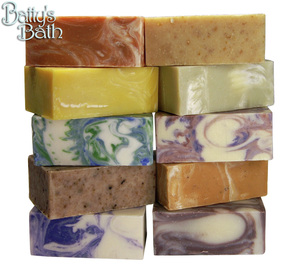
Batty's Bath Cold Press Soaps are 100% natural and made from scratch using old world techniques & ingredients. The care that was put into soap making years ago as well as the recipes that were passed down from generation to generation make their come back with these creamy, soft soaps that produce spectacular lather! The luscious lather from these soaps are not produced by any synthetic ingredients or chemical boosters; instead Batty uses specific oils in her soap batches that are known to be mild on the skin while producing great lather! In fact, they lather up so well that they can easily be used to shave with!

There are no short cuts when it comes to the cold press method - these soaps take weeks to cure but are well worth the wait! Batty's Bath handmade method of soap making ensures the most amount of glycerin possible is retained unlike commercial soap making. Retaining the glycerin makes a softer, milder soap which is emollient and moisturizing to the skin.

Batty's Bath Cold Press Soap is ideal for those with sensitive skin, for conditions such as eczema, dermatitis and psoriasis or anyone allergic to commercial soap because they don't strip the skin of its natural, beneficial oils. In fact, they are mild enough to use on babies' delicate skins.

These 100% natural soaps do not contain any synthetic ingredients, colours, or scents. Instead they are made with the freshest, highest quality natural ingredients, colored with natural clays, and scented with aromatherapy grade essential oils.

If you haven't experienced the world of Batty's Bath Cold Press Soaps then you are in for a real treat! Many bath & body lovers say that once you try natural cold press soaps that have been made with the finest ingredients and utmost care, that there's go going back to anything they were using before!

Size of Each Soap Bar: 153 g / 5.4 oz

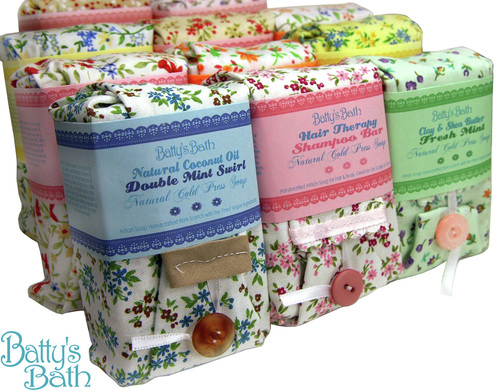
All our cold press soaps are beautifully packaged in repurposed materials and because of this no two soap wrappings look the same!Read more about our unique packaging here.

Picture
Share

Monday, January 24

What are Essential Oils?


If you've been following me for sometime, or are a serious bath & body addict, you've heard of essential oils and their healing properties. Today we will take a look at exactly what essential oils are!

So what are they?
An essential oil is a concentrated liquid usually obtained by distillation from various parts of a plant. It is an entirely natural substance, completely free of any harmful chemicals, and has the specific fragrance and aroma of the plant it was derived from. An essential oil is basically the essence of a plant. Essential oils are highly volatile, that's why they are sometimes also called volatile oils, and are also very concentrated. Therefore, they should always be handled with care.

The whole practice of aromatherapy is based around essential oils. Some of the most widely used essential oils are lavender, eucalyptus, rose, cedarwood, patchouli, orange and others. Each type of oil has its own special properties, some of which have been known from ancient times. Actually, essential oils have been used for healing purposes for centuries and they have a long tradition in various parts of the world.

Essential oils have many therapeutic uses for the prevention and treatment of both physical and psychological conditions. They can be used to heal digestive problems, skin issues, high blood pressure, anxiety, depression and the list can go on. Essential oils are either inhaled or applied directly to the skin, but only in diluted forms. A common treatment involving essential oils is a body massage. Compresses are also used to alleviate various pains. The inhalation of essential oils can be done in several ways: by placing the oils in a diffuser, which spreads the fragrance across the room, by dry evaporation or by spray.

Essential oils are also effective in dealing with stress and are commonly used for relaxation purposes. They have many benefits, but they can also become dangerous if not handled properly so leave "playing around with them" to the experts!


Share